

PowAbeam Antennas - Research... 8th November 2026
PowAbeam Antennas offer a range of high-performance VHF and UHF Yagi antennas conceived by Derek Hilleard (G4CQM) and hand-built to order by The DX Shop in the UK...
Advanced Optimized Wideband Antenna (AOWA) style and low-Q Yagis, designed for wider bandwidth and improved stability during rain, snow, or wet weather conditions.
Derek is one of the very few Radio Amateurs to own the powerful design software from Brian Beezley (K6STI) both YO7 and AO 'professional' versions.
YO uses a conjugate-gradient optimizer that combines the Fletcher-Reeves and Polak-Ribiere methods.
Yagi-Uda 100 years old
1926 came invention of the Yagi-Uda Antenna, a major breakthrough in VHF/UHF communication.
In a recent paper written by Kunio Sawaya
(Department of Communications Engineering), Tohoku University (Japan), describes a typical concept design of that time. It had three reflector elements, one exciter and twenty director elements. it was centered on 68MHz... YAGIUDA.ANT

| Concept Yagi-Uda seen in AOP | Concept Yagi-Uda Characteristics |
|---|---|
| |
| Concept Yagi-Uda Azimuth | Concept Yagi-Uda Elevation |
| |
Tribute to Günter Hoch DL6WU
For several decades now radio enthusiasts have made efforts to refine yagi designs using a range of tools. Pioneering amateurs like Günter Hoch had access to a test range belonging to the German Post Office. He carried out extensive tests on VHF/UHF yagi designs in a bid to quantify his measurements and make improvements. This led to a range of DL6WU designs which were adopted widely across the globe.
Improving designs and Trade-offs
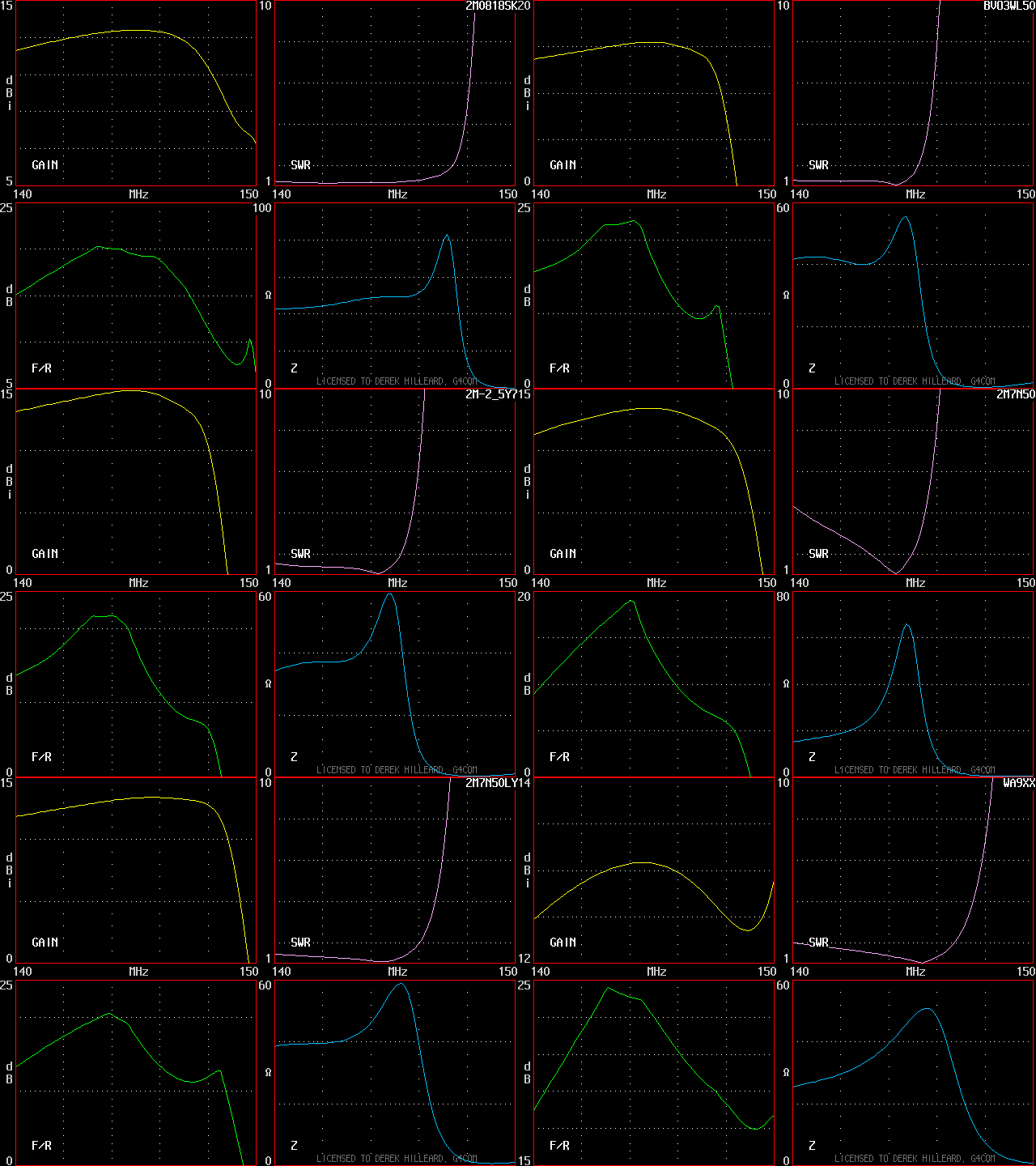
The Yagi-Uda antenna has a frequency response similar to that of a Low Pass Filter. Bandwidth has to be a high priority in design consideration along with a clean and stable polar pattern.
Seen below an animation of characteristics comparing different designs. Some past designs were gain optimized, unfortunately suffering instability during weather and proximity stress. Example 2M7N50 shows this narrow bandwidth, however slightly longer boom redesigned 2M7N50LY solves this limitation. Other designs such as the high performance BVO3WL50 by DJ9BV can be seen as very narrow band, subject to instability in wet conditions.
| Animation showing bandwidth evolution of the AOWA |
|---|
 |
Computer Assisted
Until this point in time all designs have one thing in common, designed by humans! Yes, optimizing often used, but guided by an experienced designer knowing precisely those best qualities to adopt and enhance. Tools previously included those such as Genetic Algorithm and Particle Swarm models, again requiring an experienced designer to oversee and opine.
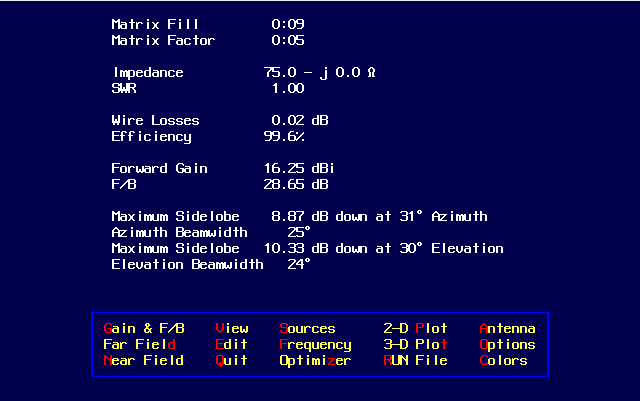
| Qwen 3.7-Plus 8 element Yagi-Uda design NEC-2 result |
|---|
 |
| Performance graphs 140-150MHz |
 |
Using Qwen Option 1 (OWA)
Just for fun... Using Super Intelligence (AI) Qwen 3.7-Plus an online resource running in the cloud designed this eight element Yagi-Uda for the 2M 144-148MHz band... QWEN8144.ANT
This Yagi-Uda is intended for direct feed... Just to be clear regarding this design the DE requires 5/8th Inch (15.875mm) OD tube, whilst the parasitic elements are all 3/16th Inch (4.7625mm) OD rod. Elements need to be insulated from a metal boom and following the DL6WU mounting directive. This requires that each element is raised more than the boom radius (r) above boom.
| Comparing designs (AI Vs HI) - NXTGENF from 2012 |
|---|
 |
| Comparing (AI Vs HI) - Performance graphs |
 |
Comparing designs
NXTGENF Yagi-Uda was designed back in 2012 employing K6STI's YO7 Pro and its conjugate-gradient optimizer. This design is somewhat longer than QWEN8144 and so delivers more forward gain. However, the other performance characteristics are directly comparable... NXTGENF.ANT
Conclusions
From the very outset this has been a light-hearted look at using AI to design a Yagi-Uda antenna. Over many years professionals and amateurs alike have made significant improvements to designs. AI is currently learning, trawling the web for resources. Humans will and must play a key role in making sure AI produces viable output! The results using Qwen have been surprising, delivering a workable design. As to its genuine originality remains to be confirmed?
NOTES
1. All G4CQM designs are calibrated to NEC, the reference-accuracy Numerical Electromagnetics Code from the Lawrence Livermore National Laboratory. Professionals and academics use NEC for solving a variety of electromagnetics problems, including antenna analysis. They have thoroughly characterized the code and most importantly validated it against actual measurement.
2. Antenna files (.ANT) use the cartesian coordinate system to refer to points in space. X and Y are in the horizontal plane and Z is height with numerical coordinate values to describe position, length and element diameter etc. Can be opened and inspected with a good text editor.
3. QWEN8144 Yagi-Uda design (Qwen text file output)
VIDEOS
Terms and conditions
These yagi antenna designs aren't for commercial use of any kind without prior consent!
Private experimenters are free to use these designs for their own personal enlightenment. However, no guarantee or warranty is offered or implied.
THIS WEBSITE DOESN'T USE COOKIES, EXTERNAL LINKS MIGHT!